GETTING TO KNOW US
As a veteran of the United States Air Force I am proud to have been given the opportunity to serve the greatest country in existence, the United States of America. Though I don't always support politicians or their policies that lead us to war, necessary or not, I will always support the American Soldier, Airman, Marine and Sailor.
Hahn Air Base, West Germany was my first duty assignment. There I learned what it meant to prepare to defend my country, primarily against the forces of communism.


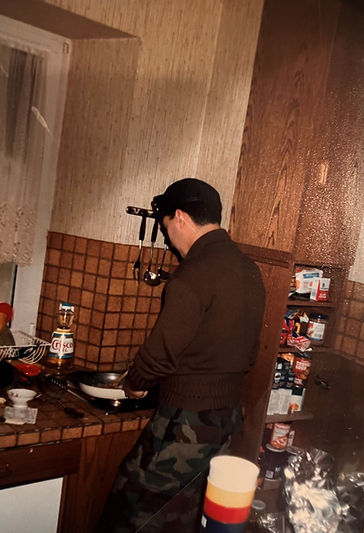
50th Security Police Bulldog representing "B Flight Security", Hahn Air Base, West Germany.

The 50th Security Forces Squadron is a component of the 50th Mission Support Group, located at Schriever Space Force Base, Colorado.
Mission
The squadron protects 34 protection-level resources and more than 8,000 military and civilian personnel assigned to Schriever AFB. The 50th SFS provides physical security, force protection measures and law enforcement services and assists commanders in maintaining good order and discipline. It monitors physical security programs supporting 12 Geographically Separated Units. The squadron also mobilizes security forces supporting higher headquarters' and national objectives.
HISTORY:
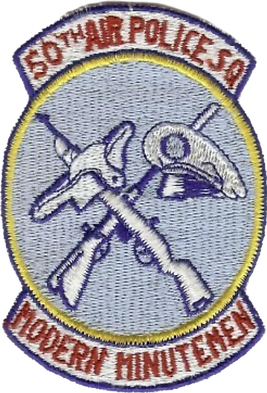
The 50th SFS was constituted as the 50th Air Police Squadron and activated at Clovis AFB, New Mexico with other units of the 50th Fighter-Bomber Wing on Jan. 1, 1953.
A component of the 50th Air Base (later Mission Support) Group, the 50th left Clovis with the wing in July 1953, arriving at Hahn Air Base, Germany in August. For the next 38 years, the squadron provided security and law enforcement to Hahn AB and other sites in the region. The squadron re-designated 50th Security Police Squadron on May 1, 1967 and on Oct. 21, 1988 was reassigned to the newly established 50th Security Police Group. The squadron inactivated with the 50th Tactical Fighter Wing on Sept. 30, 1991 and activated at Falcon AFB, Colorado on Jan. 30, 1992, replacing the 1002nd SPS. In response to world events, the security police career field transitioned into the new Security Forces career field on July 1, 1997. It included combining the security and law enforcement career fields and absorbing the combat arms training and maintenance career field into one Air Force specialty.


_jfif.jpg)




The "Rocket Cow"
A barn near Bell an der Straße was artistically and meaningfully painted by the "Düsseldorf Mural Group." A cow – representing the rural area of the Hunsrück region – has a rocket on its horns. It is intended to demonstrate the resistance of the Hunsrück residents to the storage of nuclear missiles. It has been restored several times since then and was repainted just two years ago.

History of these images:
In the 1980s there was a surprisingly peaceful movement in the Hunsrück
The reason for the peaceful uprising at the time was the fact that missiles with nuclear warheads were to be stationed again nearby, on the The Pydna missile base located in Kastellaun, Germany.
Missiles were previously housed on the site until 1981. The U.S. Army had moved into the Pydna site in 1967 and equipped the missiles with nuclear warheads, but in 1981 they left the site along with the missiles. But they were to return.
In 1979, the NATO Double-Track Decision stipulated that 96 ready-to-launch cruise missiles equipped with nuclear warheads would be stored on the Pydna site. The favorable location near the U.S. Airbase, Hahn. The fact that the missiles had already been stored there, and the favorable ownership structure (state ownership) led to the choice of Pydna.
Construction of the bunkers began in 1984. The public was largely unaware of this. At the same time, another bunker approximately 30 meters deep was also being built on the nearby Goßberg, which is in the municipality of Wüschheim. The summit was excavated 30 meters deep and transformed into the NBC (Nuclear, Biological, Chemical) bunker operated by U.S. Forces to serve as a fortified center of highly-secure communication among all NATO troops in Europe and a potential missile launch control center for the nearby missile base Pydna in case of anticipated (at that time) World War III.
The cruise missiles had a range of approximately 2,500 kilometers and could have been used in the "Cold War" against the Warsaw Pact member states.

"Death rings the bells on the Pydna" is the name of the painting which depicts two skeletons ringing a bell.
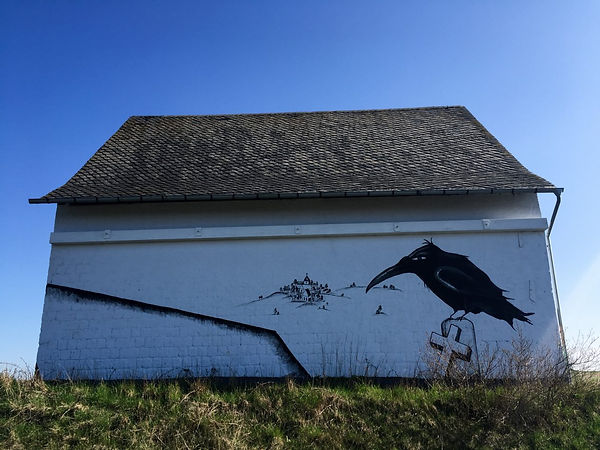
"The raven looks rather sadly at Kastellaun"